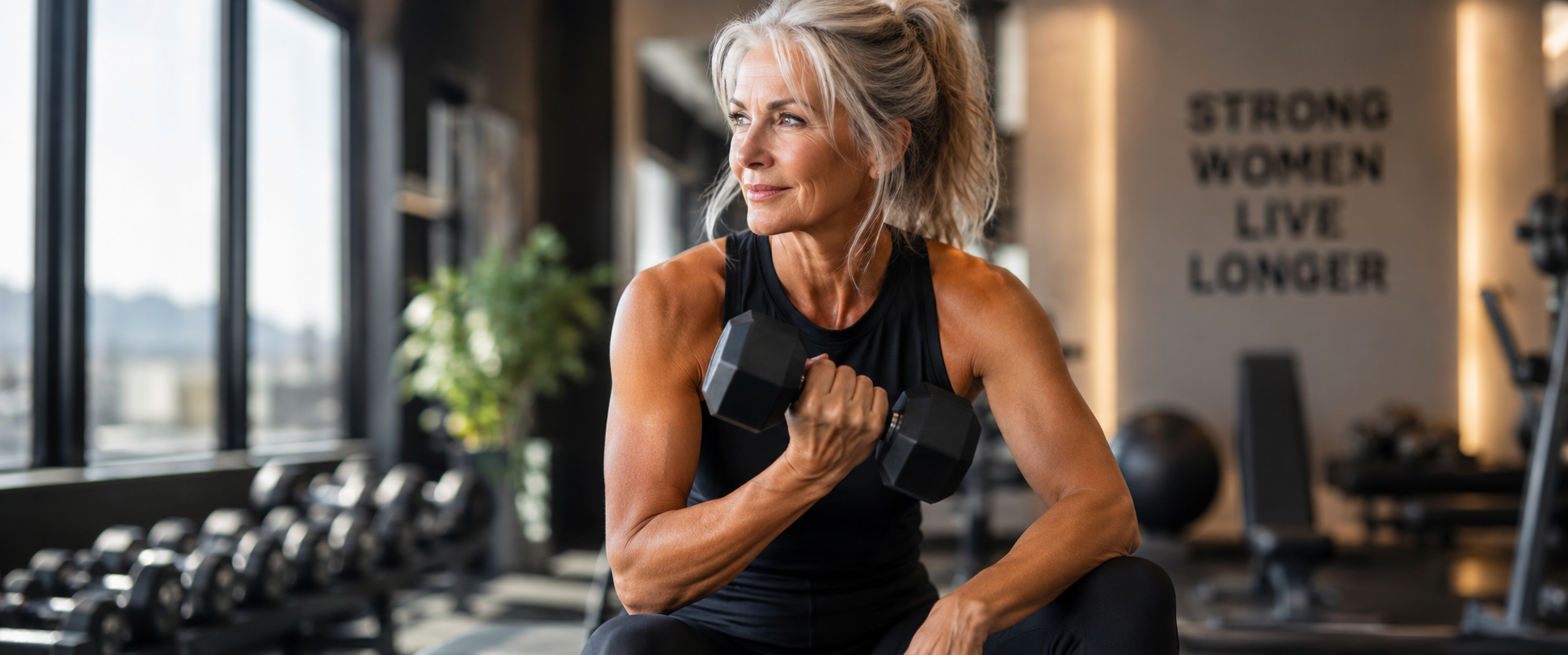
For most of the last forty years, the standard advice given to women about long-term health emphasised cardiovascular fitness. Walk more. Run if you can. Cycle. Swim. The framing was correct as far as it went, but it was incomplete. In February 2026, a study published in JAMA Network Open reframed the conversation. Researchers at the University at Buffalo followed more than five thousand women between sixty-three and ninety-nine years old over an eight-year period. The finding that mattered was direct. Muscle strength, more than aerobic capacity, was the single strongest predictor of how long these women would live and how well they would live during those years.
The Buffalo team used two simple tests, both of which can be performed without equipment. Grip strength, measured with a small handheld device. And the time it took participants to complete five unassisted sit-to-stand chair raises. Those who scored higher on both measures had a significantly lower risk of death over the following eight years. The relationship held after controlling for the obvious variables: age, body composition, baseline disease, smoking history, and aerobic fitness.
The study is part of a broader2026 shift in how the science of female ageing is being framed. For decades, medical research treated women, in the words of one widely quoted critic, as smaller men. Cardiovascular research, drug trials, and longevity studies were built around male bodies and male physiology, with the conclusions then translated, more or less, to female patients. The translation has held up unevenly. Female biology is not a smaller version of male biology.
The mechanism behind theBuffalo findings is not mysterious. After menopause, women lose lean muscle mass at a faster rate than men of equivalent age. The decline accelerates without targeted resistance training. Lower muscle mass means lower resting metabolic rate, weaker bone density, slower glucose clearance, and reduced functional capacity for daily activities. Each of those factors compounds the others. By the time a woman reaches her seventies, the difference between someone who has trained for strength and someone who has not is not only visible. It is statistically predictive of her remaining years and the quality of those years.
Strength training, in this context, is not a fitness preference. It is a longevity intervention with a direct, measurable effect on lifespan. The Buffalo study is one of the larger and longer pieces of evidence to confirm what longevity researchers have been arguing for several years: cardio extends years; strength extends healthy years.
The Buffalo study lands in a year when female-specific health research is finally receiving the attention and funding it has long lacked. Innova Market Insights, in its 2026 Top HealthTrends report, identified Her Health as one of the defining nutrition and wellness themes of the year. Within longevity science specifically, researchers are increasingly studying organ-specific ageing, with particular focus on ovarian reserve as a driver of female systemic ageing. Hormone replacement therapy, freed in late 2025 from the regulatory black box warning that had restricted its use for more than two decades, is being repositioned as a longevity tool rather than only a treatment for symptoms.
The cumulative effect is amore accurate picture of what healthy ageing actually looks like for women. It involves protecting hormonal architecture, building and maintaining lean muscle, prioritising sleep, managing stress through dedicated practice, and screening proactively for the conditions that disproportionately affect older women, including osteoporosis, cardiovascular disease, and cognitive decline.
For senior women on LeadingLadies' membership rolls, the implications of the Buffalo findings are concrete. Three principles deserve attention.
The first is that strength training is no longer optional for long-term health. Two or three sessions a week, focused on compound movements such as squats, deadlifts, presses, and rows, will preserve and build the lean muscle that the data identifies as protective. Bodyweight work has a place, but for women over forty, the evidence increasingly supports adding external load. The intervention that produces the largest measurable longevity benefit is the one most women have spent their lives being told was unnecessary.
The second is that the standards have shifted. Aerobic fitness alone is no longer the marker of a healthy long life. The current evidence suggests that grip strength, leg strength, and the ability to perform basic functional movements, such as rising from a chair without assistance, are stronger predictors than treadmill performance. Those metrics are simple to track and accessible to almost any clinician.
The third is that the framing of fitness, for women in their forties, fifties, and beyond, deserves updating. A workout is not primarily a cosmetic activity. It is a deposit in a long-term account that pays out in the years between sixty and ninety. The investment thesis is unusually clear. Women who train for strength now reach those decades with the muscle, bone density, and metabolic function that allow them to remain active, mobile, and independent.
Strength does not market well. It is not as photographable as a yoga retreat or as glamorous as a longevity clinic in Switzerland. The serious longevity work, in the data now emerging, is conducted in gyms, on basic equipment, with attention to compound movements that women have historically been encouraged to avoid. That work compounds over years. It is not optional, and it is not easily replaced by other forms of exercise.
For the senior women whose careers, families, and contributions depend on remaining functional and present for the decades ahead, strength is the quiet currency. The Buffalo study did not invent that conclusion. It merely confirmed, with five thousand subjects and eight years of follow-up, what the longevity researchers have been saying. The body that lifts will, statistically, outlive the body that does not.
That is the conversation worth having, and the discipline worth building
Sources:
JAMANetwork Open, University at Buffalo study (February 2026);
Innova MarketInsights Top Health Trends 2026;
Longevity India Initiative research summaries;
Women's Health Initiative follow-up studies;
FDA HRT regulatory update (2025).
Leading Ladies is a members-only network for women at the top, founders, CEOs, investors, and board members. We host exclusive events, facilitate meaningful connections, and share the insights that define tomorrow's leadership.